From family to team
Six years ago I wrote a dissertation on how organisations create value through the relationships between people. Then the world changed — three times.
Six years ago I wrote a dissertation on knowledge management. How organisations create value through the relationships between people. How information flows — or fails to flow — through the invisible lattice of social ties that exists beneath every org chart. I was looking at social networks, knowledge transfer, intellectual capital, and the question of whether any of it could be measured in a way that a business would actually find useful.
The research led me to propose a Knowledge Value Chain framework, adapted from Porter and Ermine, and a concept I called the Social Factor — the idea that social capital is better understood as a multiplier of human capital than as an asset in its own right. I tested the theory against a small enterprise going through a transformation programme, using Social Network Analysis on their Microsoft Teams data. It was 2020, a few months into the pandemic, and the timing turned out to be more interesting than I could have appreciated at the time.
Then the world changed. Three times, in quick succession, each one reshaping the conditions under which the original ideas had been formed.
First, COVID forced most knowledge workers home — and the collaboration platforms I had been analysing for one company were suddenly generating behavioural data at a scale that no planned research programme could have achieved. What had been a niche academic exercise became a global dataset. The invisible architecture of who talks to whom was, for the first time, comprehensively recorded.
Second, Organisational Network Analysis grew from a research method into a product category. Microsoft Viva Insights, Worklytics, Humanyze, Polinode — tools that do at industrial scale what I had done manually with Teams analytics for twenty-five people. The patterns I found in one small firm could now be validated or contradicted across thousands of organisations.
Third — and this is the one I am still working through — AI agents entered the network. The dissertation identified human roles that shape information flow: brokers, gatekeepers, boundary spanners, connectors, energisers. People who hold the invisible infrastructure together through judgment, trust, and the relationships they maintain. Now large language models and agentic systems are beginning to occupy some of those same positions.
I want to walk through the original ideas with six years of distance and a substantially different landscape, and see what held up, what needs revision, and what I missed entirely.
Knowledge exists in three states — and only one moves easily
The dissertation started from a straightforward observation: organisations do not lack information. They lack flow. The volume of communication has never been higher — more messages, more meetings, more platforms — and yet knowledge regularly fails to reach the person who needs it.
Knowledge management has been theorised for decades. Nonaka and Takeuchi mapped the creation process. Davenport defined the management cycle. Ermine adapted Porter's value chain for knowledge transformation.1Nonaka & Takeuchi (1995), The Knowledge-Creating Company. Davenport (1994), earliest formal KM definition. Ermine (2013), Knowledge Management Value Chain adapted from Porter's Value Chain (1985). But most frameworks describe knowledge creation without accounting for the network dynamics that determine whether created knowledge ever reaches someone who can use it.
Polanyi wrote in 1966 that we "know more than we can tell" — a sentence that has aged remarkably well. Tacit knowledge is embodied in people, formed through experience, and only transfers through interaction, observation, and shared practice. Explicit knowledge — documents, databases, codified procedures — moves easily but carries the least contextual value. Between the two sits implicit knowledge, accessible through conversation and enquiry but dependent on the motivation of both parties.2Polanyi (1966), The Tacit Dimension. Liebowitz & Beckman (1998) introduced implicit knowledge as the bridge between tacit and explicit. Bender & Fish (2000): "Knowledge formed by an individual could differ from knowledge possessed by another person receiving the same information."
The conversion between these states — what Nonaka and Takeuchi called the SECI cycle: socialisation, externalisation, combination, internalisation — is never complete. Gourlay, Ribeiro and Collins all argued that full tacit-to-explicit conversion is impossible. Nonaka himself conceded both types exist on a continuum. The practical consequence: organisations cannot capture their most valuable knowledge into systems. They can only create conditions for it to flow between people.
And "between people" means through networks. That was the thread I started pulling on in 2020, and six years later the thread is considerably longer than I expected.
The invisible architecture
Every organisation operates two structures simultaneously. The formal one — hierarchy, reporting lines, job titles — describes authority and accountability. The informal one — who actually talks to whom, who trusts whom, who goes to whom for expertise — describes how knowledge moves.
Social Network Analysis makes the second structure visible. It rests on three assumptions I found compelling then and find even more so now.3Fowler & Johnson (2011): individual and group attributes are interdependent and contextual. Granovetter (1973): structural mechanisms via social interactions affect perceptions, beliefs, and actions. Network structures are dynamic — they change with time, policy, and people. Individual and group attributes are shaped by the relationships around them. Social interactions shape how people think and behave. And networks are dynamic — they evolve continuously with time, policy, objectives, and the people within them.
Within these networks, several roles emerge that never appear on any org chart. Granovetter showed in 1973 that weak ties — acquaintances, peripheral contacts — are disproportionately valuable because they bridge dense, separate groups and carry non-redundant information. Strong ties provide credibility and regulate speed, but weak ties provide reach and novelty. Burt showed that the gaps between unconnected groups — structural holes — are opportunities for actors who can span them. Coleman showed that dense, closed networks promote trust and norms, but at the cost of insularity.4Granovetter (1973), The Strength of Weak Ties. Burt (1992), Structural Holes. Coleman (1988), social capital as facilitator of action within closed networks.
Brokers sit between groups — some keeping them apart to control information, others joining them together to enable collective benefit. Gatekeepers control inflow and outflow while translating between different vocabularies and norms. Arena described an adaptive space populated by connectors who discover ideas, energisers who diffuse them, and challengers who pressure-test them before they enter formal systems.5Arena (2018), Adaptive Space. Four connector types: discovery (brokerage), development (inflow gatekeeping and social cohesion), diffusion (energising, spreading ideas), disruption (challenging, facilitating network closure around validated ideas).
These roles are emergent. They arise from network dynamics, not from job descriptions. And they determine whether knowledge flows or stalls far more reliably than any formal communication policy.
The tension between Coleman's closed networks and Burt's structural holes is worth sitting with. Closure promotes trust, shared norms, and the ability to sanction — it makes teams reliable. Structural holes promote access to diverse information, timing advantages, and combinatorial thinking — they make organisations innovative. Both are true. Most organisations lean heavily toward closure and then wonder why their ideas plateau. The tendency of individuals to connect with similar others — homophily, as Lazarsfeld and Merton called it in 1954 — amplifies the lean, especially when combined with triadic closure, where two people connected to a common third tend to connect with each other. The resulting dense, comfortable clusters are excellent for execution and terrible for learning.6Lazarsfeld & Merton (1954), homophily. Asikainen et al. (2020): induced homophily (homophily + triadic closure) amplifies the effect, leading to homophilic constraints. McPherson et al. (2001): the more attributes in common, the greater the homophily.
The knowledge value chain
I adapted Ermine's Knowledge Management Value Chain, which itself drew on Porter, to try to capture the full picture. The standard value chain describes how inputs become outputs become competitive advantage. Ermine mapped this onto knowledge transformation. My extension was to argue that the value chain as a sequential process does not capture the reality of how knowledge-intensive firms actually work.
In practice, knowledge creation is the product of multiple asynchronous streams of information running at different velocities through a dynamic lattice of social ties. The transformation of inputs — people, policies, processes — into outputs — intellectual capital — and outcomes — performance, competitive advantage — depends on primary activities and enabling factors working simultaneously.
The DIK cycle — data to information to knowledge — sits at the centre and is the engine, but it runs through people who operate in networks. Training and practices develop the individual skills. Network dynamics — the norms, routines, trust, and informal ties — create the channels through which knowledge circulates. Sharing is what connects them, and I came to see it as indispensable rather than merely enabling. Without sharing, the cycle produces knowledge that stays trapped in individual heads, and the firm never builds an organisational memory.
Underneath all of this, enabling factors set the conditions. Leadership style, organisational culture, structure, values, the stability and continuity of social relationships. Misztal wrote about how stable social structures influence the clarity of mutual obligations. Coleman described how institutional settings are conducive to the development of social capital. Barnard, back in 1938, understood that coordination itself is an enabling factor. These are the things management can actually influence — and they matter because they determine the efficiency of everything above them in the chain.
The model is multidimensional. The DIK cycle operates at three embedded levels — individual, group, organisation — with spill-overs between layers. I used an analogy I still find useful: a biological organism breathes in oxygen to release energy, converting chemical substances to fuel the living process, eventually to survive in its environment. A firm absorbs information from the environment, transforms it through social interactions and individual judgment, attitudes, skills and knowledge, and produces the capability to compete. The outer layer of the organisation provides the conditions — structure, policy, culture, leadership — that directly influence the formation of both formal and informal groups. The consolidation of routines, norms and practices feeds trust and cohesiveness. Gatekeepers, boundary spanners and brokers ease the exchange and assimilation of information, lowering barriers and accelerating knowledge transformation.
Then sixty-one thousand people went home
In early 2020, most knowledge workers were sent to work remotely. The shift was not designed — it was imposed. And because it happened through collaboration platforms, it generated behavioural data at a scale that no planned experiment could have achieved.
Yang et al., Nature Human Behaviour — 61,182 Microsoft employees tracked before and after the shift to remote work. The collaboration network became more static and more siloed. Fewer bridges across groups. A shift from synchronous to asynchronous communication. Employees added fewer new collaborators and shed fewer existing ones. The network froze.7Yang et al., "The effects of remote work on collaboration among information workers," Nature Human Behaviour. 61,182 employees. Pre/post WFH mandate. Strongest peer-reviewed evidence on remote work network effects. The mandatory shift approximated a natural experiment.
HBS "Silos That Work" — more than 360 billion emails across thousands of organisations. Modularity increased. Communication intensified within smaller subgroups while cross-group interaction declined. More email volume did not translate into more cross-boundary connectivity.8Harvard Business School summary of large-scale email network research. 360+ billion emails across thousands of firms. Confirms the Microsoft finding generalised beyond a single company or tool stack.
The consistent finding across these and several supporting studies is that remote and hybrid work did not reduce communication. It changed its shape.
Networks became more locally dense, more modular, and weaker in the cross-boundary bridging ties that carry novel information between groups. Platforms maintained workflow continuity but did not recreate the informal, spontaneous ties that physical proximity generates. Organisations communicated more while knowing less across boundaries. The knowledge flow problem I had described in theory was now visible in data, at global scale.
Microsoft Research tracked more than 10,000 new hires in 2022 and found that network size grew during onboarding — especially through instant messaging — but structural diversity remained fragile without deliberate support. Longitudinal ONA work from Cushman & Wakefield, following 550 employees across pre-COVID, fully remote, and return-to-office phases, showed that relationships were redistributed, disrupted, and rebuilt differently depending on work mode and workplace design.9Microsoft Research (2022): 10,000+ new hires, IM networks gained structural diversity during onboarding but diverse cross-team networks required design support. Cushman & Wakefield / Work&Place: 550 employees tracked longitudinally across in-office, remote, and return-to-office phases.
The practical finding from applied ONA is that if digital channels mirror the old hierarchy, they digitise silos. Platforms can accelerate network rewiring or freeze old structures depending on governance, norms, and channel design. The question that matters is not which platform a company uses but what architecture the platform enforces.
Bottlenecks are multicausal
One of the strongest findings to emerge from the last six years comes from Bunger and colleagues, who in 2023 reviewed 53 studies on deliberate network alteration strategies. They identified eight families of intervention — creating groups, changing the environment, changing composition, improving networking skills, improving network awareness, changing actor prominence, changing motivations, and targeting specific ties.
The average successful intervention used 2.4 of these strategies simultaneously.10Bunger et al. (2023), Developing a typology of network alteration strategies for implementation. Scoping review of 53 empirical studies. Eight strategy families identified. Average intervention used 2.4 strategies. Most successful approaches combined context-level, actor-level, and tie-level interventions. This confirms something I observed in my research but could not generalise from a single case: bottlenecks in knowledge flow are multicausal, and single-lever fixes do not resolve them. Changing the org chart alone does not work. Deploying a new platform alone does not work. Training alone does not work. The organisations that successfully rewire their networks do it by intervening across multiple dimensions at once — structure, culture, tooling, training, leadership.
Saatchi and colleagues, reviewing network interventions in healthcare settings, found that project-based rewiring — grouping previously disconnected actors into cross-cutting projects — produced measurable topology change within six months: higher density, lower average path length, more cross-boundary ties.11Saatchi et al. (2023), systematic scoping review of network approaches and interventions in healthcare settings. Benton et al. case: less-connected nurse leaders grouped into cross-cutting projects; six months later the network showed higher density, lower path length, more cross-area ties.
On timing, the best available benchmarks suggest visible topology shifts can emerge within three to six months if supported by repeated interaction opportunities, while stable, self-reinforcing patterns usually need six to twelve months or more. Small firms may rewire faster — fewer layers, shorter paths, less inertia — but the academic evidence remains surprisingly thin. A scientometric review of 441 SME network studies found the field overwhelmingly focused on external ties. Internal employee communication networks in small, knowledge-intensive firms are almost unstudied.12Scientometric review of social network theory applied to SMEs (441 studies, 1994–2022): dominant focus on inter-firm and founder networks. Internal employee-level communication structure in sub-100 employee firms is severely underrepresented in longitudinal research.
A warning from the longitudinal research. Interventions can unintentionally recentralise networks. If a new expert gains prominence after a bottleneck is removed, preferential attachment — people connecting to already-connected nodes — can recreate the same problem in a different location. A Canadian public-health study tracking information-seeking networks found exactly this: staff preferentially formed ties to those already prominent, even during interventions designed to distribute leadership. Decentralisation must be monitored, not assumed.
Xu and colleagues added a useful mechanism in 2021: shared leadership networks become more decentralised as teams develop transactive memory — knowing who knows what. When expertise becomes visible across the team, network traffic can bypass old bottlenecks without collapsing coordination. The practical implication is that bottlenecks often persist because staff lack visibility into one another's competence, and once that visibility improves, the network architecture shifts on its own.13Xu et al. (2021), emergence of shared leadership networks in teams. Transactive memory systems promote decentralisation. Leadership density increases when members know who has relevant expertise.
Absorptive capacity in a different era
The concept of absorptive capacity — a firm's ability to recognise, assimilate, transform, and exploit external knowledge — was central to the dissertation. Zahra and George defined it as the sum of potential capacity (acquire and assimilate) and realised capacity (transform and exploit), mediated by social integration mechanisms.14Zahra & George (2002): absorptive capacity = potential (ability to acquire and assimilate) + realised (ability to transform and exploit). Social integration mechanisms reduce friction between the two.
The 2020–2026 evidence adds something I did not anticipate. Collaboration platforms now expose organisations to vast amounts of external information — shared links, industry feeds, competitor analysis, research papers, AI-generated summaries. The bottleneck has shifted. Six years ago, the problem was often access. Now the problem is integration. Firms are drowning in information they cannot metabolise because the internal network that should be processing it is siloed, frozen, or routed through bottlenecks.
Absorptive capacity has always been a network-dependent capability. A firm with strong internal knowledge flow can recognise relevant external information faster, because more diverse ties mean more exposure. It can assimilate it more effectively, because trust-based sharing lowers friction. It can transform it into capability, because cross-functional collaboration enables combinatorial thinking. And it can act on it before competitors, because shorter network paths mean faster decisions.
A firm with siloed or bottlenecked internal networks cannot do any of this efficiently, regardless of how much external information it can access. The volume and velocity of what needs to be absorbed has changed dramatically. The capacity to absorb it depends on the same invisible architecture it always did.
The Social Factor
The dissertation's most speculative contribution was a challenge to how social capital is typically framed.
The standard accounting approach treats intellectual capital as the sum of human capital, social capital, and structural capital. I argued this addition is wrong. Social capital, as traditionally defined, cannot be directly invested in or measured as capital. A firm cannot spend a budget line to produce better social relations. What a firm can do is invest in human capital — skills, knowledge, training — and create conditions for social interactions to multiply that investment.
I proposed calling this the Social Factor: a ratio expressing the efficiency of a firm in transforming knowledge into competitive advantage through the quality of its social relations. If the factor is greater than one, social interactions are efficient and human capital investment yields compounding returns. If it is less than one, knowledge is trapped and investment is dampened. It can never be zero — that would mean a firm with no relationships whatsoever, which is structurally impossible in any functioning organisation.
This reframing shifts the management question from "how do we measure social capital?" — which has eluded consistent answers for decades — to "how do we improve the Social Factor?" — which is a question about network design, culture, leadership, and structure. All of which can be influenced.
The resulting output I called Collective Capital — the knowledge generated by networks that no individual could produce alone. Greater than the sum of its parts, as Aristotle would have put it, and irreducible to the contributions of any single actor. Relational ties are always co-owned by both parties, and what they produce together belongs to the network, not to either individual. That is why I argued social capital is a misnomer — you cannot own capital that depends equally on someone else for its existence.
When AI enters the network
The dissertation mapped a set of human roles — brokers, gatekeepers, boundary spanners, energisers — and showed how they shape information flow. These roles require judgment, trust, context, and the kind of relational capital that accumulates slowly between people who work together long enough to develop shared understanding.
Large language models and agentic AI systems are now entering the same network topology. They surface knowledge from repositories, reducing dependency on human experts for information retrieval. They bridge structural holes by connecting people to relevant content across silos they would never have reached through their existing ties. They translate between teams with different vocabularies, norms, and assumptions. In network terms, they perform some of the functions of brokers and boundary spanners — the information-routing functions, at least.
What they do not do — and this is where I think the interesting question lives — is build trust. They do not carry social capital. They do not create the conditions for collective learning in the way that a human weak tie does, where the mere act of reaching across a boundary to an acquaintance changes both parties' understanding and expands the network's combinatorial surface.
The Social Factor I proposed assumed those interactions were between humans. If AI agents now mediate a growing share of knowledge routing, the composition of the factor changes. Some components — information accessibility, speed of retrieval, cross-boundary visibility — may improve substantially. Others — trust formation, tacit knowledge exchange, the slow accumulation of shared context that makes a team more than a group of individuals — may be unaffected or even eroded if human interactions are displaced rather than augmented.
What happens to the value that lives between people when the systems mediating their work are no longer tools, but actors?
I do not have a settled answer here. I have the shape of the question, and I think it is the right one to be asking. The framework — knowledge flows through networks, networks are shaped by structure and culture and leadership, the quality of those networks multiplies or dampens every other investment — holds up after six years. What needs updating is the assumption that the network is purely human. It is not, anymore.
What shapes the flow
The literature and the evidence converge on the same conclusion I reached in the dissertation, now with considerably more data behind it. Knowledge flow is shaped by the interaction of multiple factors, and no single lever moves it.
| Dimension | What it includes | When it breaks |
|---|---|---|
| Structural | Hierarchy, span of control, specialisation, boundary permeability, cross-functional mechanisms | Rigid silos, mandatory passage points, information routed through rank |
| Cultural | Shared values, psychological safety, tolerance for vulnerability, norms around challenge | Clan comfort substituting for accountability, fear of speaking up |
| Relational | Trust, reciprocity, quality of weak ties, visibility of expertise, willingness to share | Homophilic clustering, hidden expertise, hoarded knowledge |
| Technological | Platform architecture, channel design, whether digital spaces enable lateral connection | Platforms that digitise the existing hierarchy |
| Managerial | Leadership style, HC investment, deliberate creation of interaction opportunities | Centralised control, underinvestment, assuming networks self-repair |
These interact multiplicatively. A firm with excellent tools but low trust will digitise its dysfunction. A firm with strong culture but rigid structure will generate ideas that cannot reach decision-makers. The unique blend — and the willingness to intervene across all dimensions simultaneously — is what produces flow.
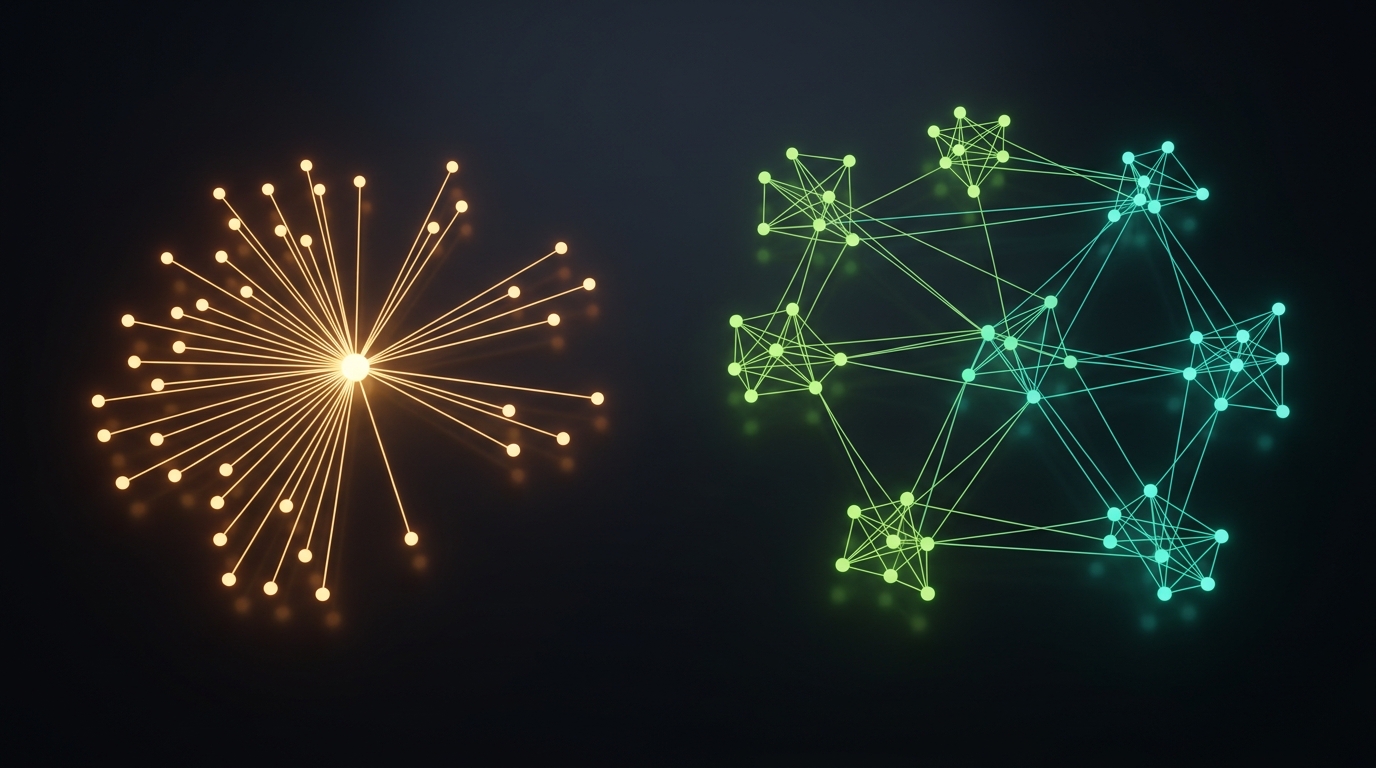
The "family to team" transition captures this. "Family" is the default — dense local clusters, knowledge routed through a few trusted central actors, strong internal cohesion within groups, weak bridging across boundaries, clan culture where loyalty substitutes for accountability. It feels warm and it works, until it does not. "Team" is intentional — distributed ties, visible expertise, cross-functional collaboration by design, shared values that include challenge and accountability alongside trust. It requires deliberate network architecture, sustained managerial effort, and the willingness to measure whether the invisible structure is actually changing.
Most organisations are somewhere in between, often closer to family than they realise. The ones that reach team and sustain it treat their network as something they design and maintain — the same way they design and maintain their products, their processes, and their technology.
Six years on, the framework holds. The landscape around it has shifted enough to make the ideas more testable and more urgent. And the question that has emerged since — what happens to the value that lives between people when the systems mediating their work are no longer tools, but actors — is the one I am spending most of my time on now.